Never the same A twice
How I turned my handwriting into a design system an agent can run
Organic doesn't mean unrepeatable.
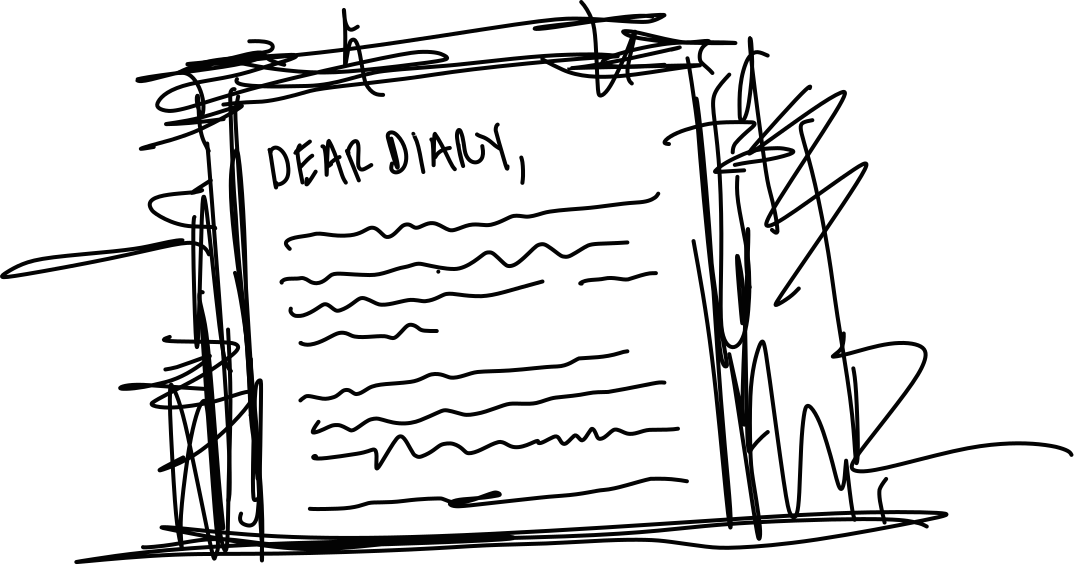
Every header at the top of this newsletter is written in my handwriting... but I didn’t write a single one of them.
That’s not a riddle. It’s a design system, and it’s the most fun I’ve had building something in a long time.
Here’s the problem I was trying to solve. Handwritten typefaces always feel a little fake, and it takes most people a second to figure out why. Take this scribbled font in Figma and type out a word with a few repeated letters in it. Every other E is the same E.
Nobody’s hand does that.
Your brain clocks the repetition before you do, and the second it does, the whole thing stops reading as handwriting and starts reading as artificial.
Drummers figured this out a long time ago. Fire the identical snare sample twice in a row and it sounds like a machine gun (producers literally call it the machine-gun effect), so good sample libraries record the same hit over and over and rotate through the takes. Same drum, same drummer, never the same hit twice.
So I recorded my own takes.
I write exclusively in all caps, which made the job smaller than it sounds: twenty-six letters and ten numbers. I sat down and wrote every one of them over and over until I had at least ten versions of each, done while recording a Loom of myself writing the whole alphabet and handed it to Claude.
The video was the part that mattered. A scan of a letter tells you its shape. A video tells you where the pen started, which way it moved, and how fast. So instead of tracing outlines, we traced the center line of every stroke in the order I actually drew it, and measured my pen speed straight off the footage (yes, really).
When a header animates, it isn’t a font fading in. It’s my pen re-walking the exact path it took the first time.
I never wrote a single piece of punctuation, either. Every comma and question mark in these headers is built out of fragments of my own letters.
Straight from the SVG sets I delivered to the bot.
Then I gave it rules.
A pile of letters isn’t a system. The rules are what make it one.
Never the same A twice. Every time a letter shows up in a title, it pulls a version that hasn’t been used yet.
The ink never sits still. Every other frame, the strokes shift a hair, like stop-motion, so even the finished title has a little shiver to it.
Same pen, any size. The line weight is locked to a physical nib, so big type doesn’t turn into blobs.
Then it writes itself onto one of 57 scraps of paper, and that’s a header.
Here’s the crazy part: now it goes anywhere. The same alphabet runs the GIFs in your inbox, as stills, and a little web package that drops my handwriting onto any website. An agent can spin up a week of headers in one sitting and every one of them looks like I sat down at my desk with a pen.
Organic doesn’t mean unrepeatable. It means variation you can’t predict, built on rules you can. Capture enough of the first, write down the second, and anything handmade becomes something you can scale without it going stale.
It is 100% possible to make a design system that doesn't feel artificial.
— Zach